Payload and Sensor Testing in the Flow: Cameras, Lidars and Antennas Under Load
October 30, 2026
Why 300-400 km/h FPV interceptor drones need wind tunnel testing: tip compressibility, cube-law drag power, structural loads, and why fan arrays fall short.
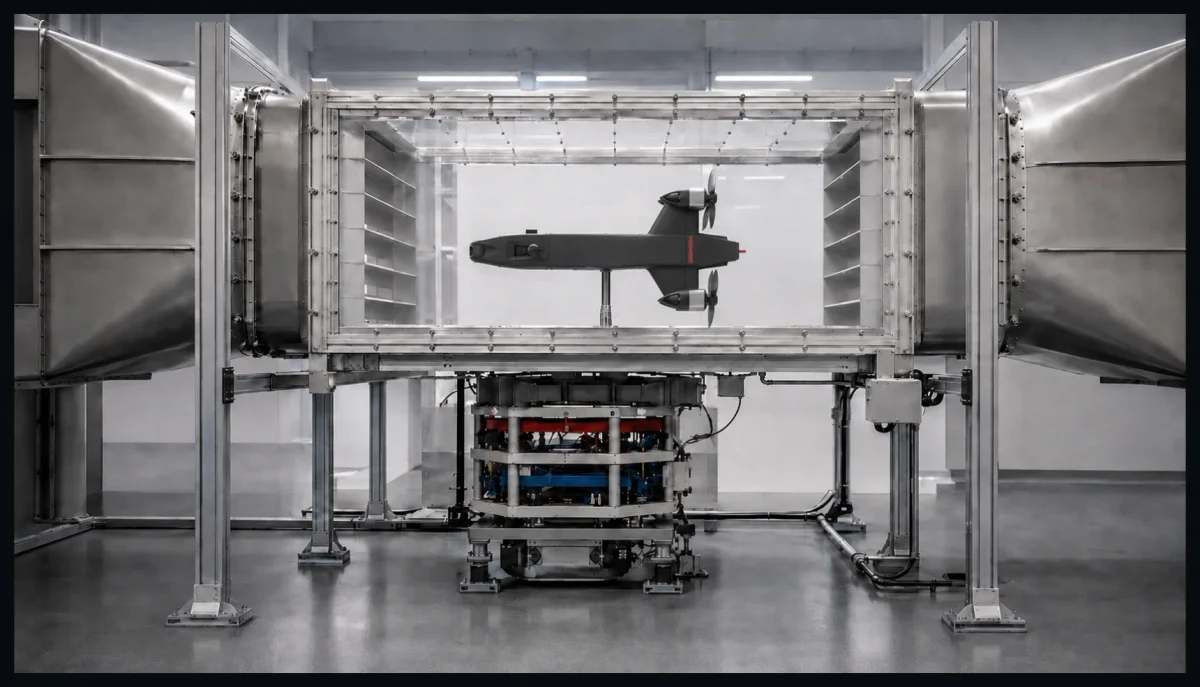
Three hundred to four hundred kilometres an hour sounds like a speed regime with room to spare before anything interesting happens aerodynamically — well below the speed of sound, well inside the territory every textbook calls "low-speed, incompressible flow." For the airframe as a whole, that's roughly true. For the propeller spinning at the front of it, it is not.
High-speed FPV testing exists because the fastest-growing segment of small rotary UAVs — racing drones and, increasingly, interceptor drones built to run down other aircraft — has quietly walked past the assumptions that the rest of small-drone development still relies on.
A drone's forward speed and a propeller blade's tip speed are two different numbers, and the second one is always larger — often by a wide margin. FPV racing propellers commonly spin at 25,000 to 50,000+ RPM , with the fastest setups exceeding 60,000 RPM at full throttle.
Do the arithmetic on a typical 5-inch racing propeller (127 mm diameter, 63.5 mm tip radius) at 50,000 RPM: tip speed from rotation alone works out to roughly 330 m/s — within a few percent of the speed of sound at sea level. Add the aircraft's own 300–400 km/h (83–111 m/s) of forward flight, which adds directly to the advancing side of the disk the way it does on any rotor in forward flight, and the local flow the advancing blade tip actually sees can push past Mach 1 in the worst case, or sit deep in the transonic regime even when it doesn't.
That matters because propeller efficiency does not degrade gracefully as local Mach number climbs through the transonic range — it falls off a cliff, in a well-established aerodynamic effect familiar from any propeller or rotor design: shock formation on the blade, sharply rising drag, and a step change in noise, all concentrated in the last few centimetres of blade that were designed for a much gentler flow regime.
Aerodynamic drag power rises with the cube of airspeed. Going from a sedate 100 km/h to 400 km/h is a 4× increase in speed — and a 64× increase in the power needed just to hold the aircraft against drag, before the propulsion system does anything else. Every design assumption that worked at survey or delivery-drone speeds — motor sizing, battery C-rate, thermal margin, structural loads sized against "normal" airspeed — was built for a completely different point on that curve.
The airframe survey and cargo platforms most FPV development still targets fly at 0–100 km/h. At that end of the curve, aerodynamic drag is a secondary design concern behind weight and hover efficiency. At 300–400 km/h it becomes the dominant one.
Dynamic pressure — the quantity that drives aerodynamic loads on the frame, arms and canopy — scales with velocity squared. A racing-class airframe built from 3D-printed plastic and carbon fibre for minimum weight, not for load margin, sees roughly 16× the aerodynamic load at 400 km/h that it saw at 100 km/h. That load lands on arms, motor mounts and a canopy that were optimised to be as light as the frame allows, not to survive a load case four times the speed anyone tested for when the platform was designed.
The people already pushing this envelope have responded by treating the whole airframe as an aerodynamic problem, not just the propulsion system. The current Guinness World Record for fastest quadcopter — 657.59 km/h, set with a purpose-built machine using 6-inch propellers, uprated 900 kV motors and a body 3D-printed as one continuous piece — was developed with the exterior shape optimised in aerodynamic simulation specifically to cut drag, not just to look fast.
The clearest real-world driver is defensive: Ukrainian FPV interceptor drones built to catch and destroy reconnaissance drones have publicly reported speeds around 325 km/h. The logic is straightforward — a common reconnaissance platform cruising at roughly 110 km/h, with a maximum speed around 150 km/h, has to be run down before the interceptor's battery runs out, and every extra km/h of interceptor speed directly shortens that chase. This is not a niche hobbyist pursuit; it is an active, fast-iterating category with a hard performance requirement behind it.
A fan array wind generator's commercial ceiling sits around 58 m/s — roughly 209 km/h — even with a convergent fitted to concentrate the flow. That is a little over half of what a 300–400 km/h interceptor needs. This isn't a matter of the fan array being the cheaper or less capable option; above roughly 200 km/h it is not an option at all. A closed-circuit wind tunnel, built to sustain high dynamic pressure in a small, well-conditioned test section, is the only facility class that reaches this speed range with the flow quality to produce usable data.
Tell us your target speed and propeller class , and we'll scope a test section and instrumentation package built for this speed range — not adapted from a facility designed around slower platforms. Related reading:
fan arrays versus closed-circuit tunnelsand
propeller thrust test stands.
Talk to our engineering team about high-speed FPV drone testing